
Most businesses don't choose ERP because they “want ERP.”
They choose it because something doesn't work as it should.
It doesn't always look clear.
But there.
Everyday life is starting to get heavy.
Procedures are delayed.
The information is not clear.
Decisions take time.
And that's where the main problem begins to become apparent.
There is no single function.
In an ERP-free business, everything exists.
But they're scattered.
The data is in different places.
The departments operate with their own image.
The information is transferred instead of being available.
And this creates inconsistency.
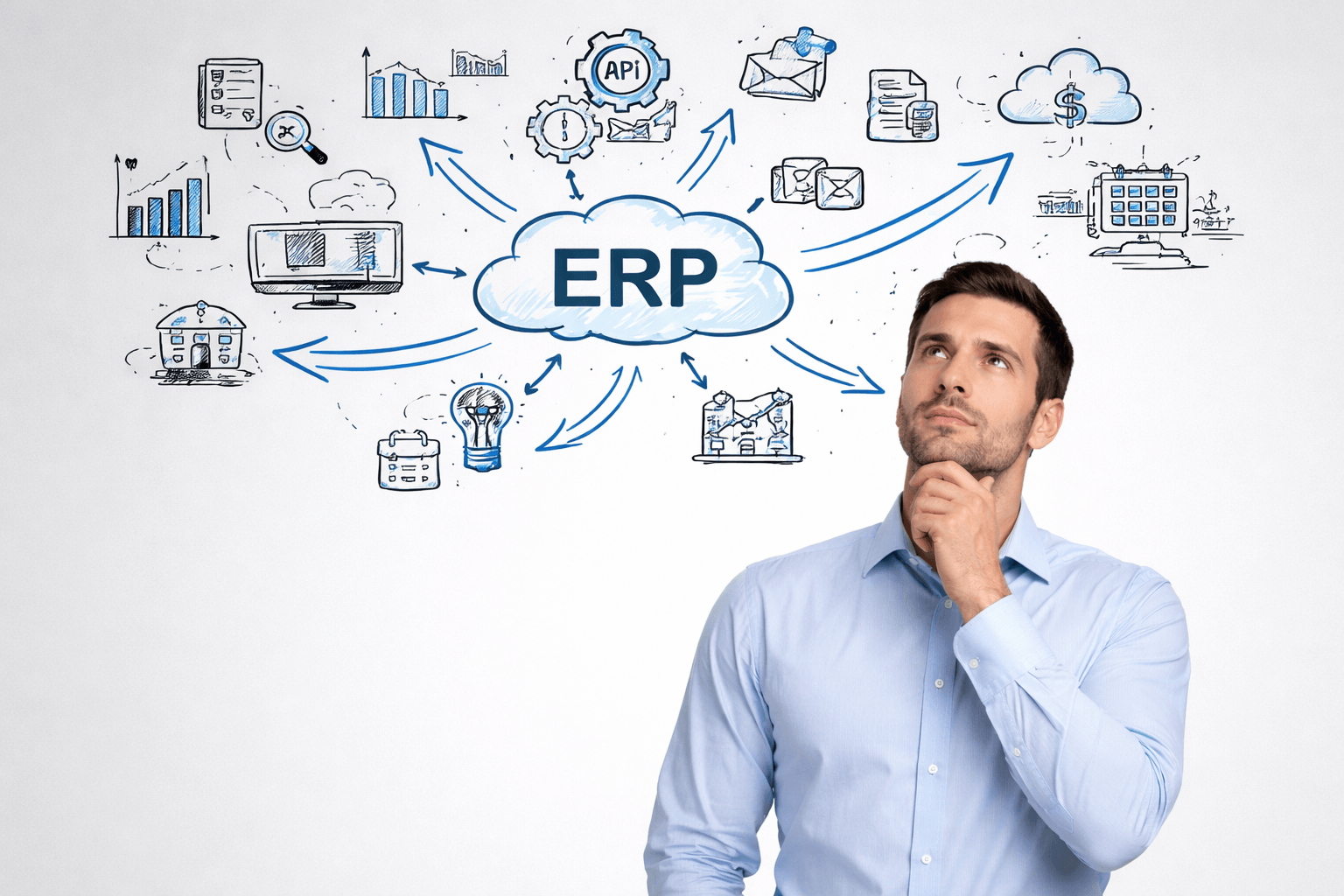
ERP comes to solve just that.
Integrates data, processes and functions into one system.
The whole business is working on the same information base, in real time
And that changes how everything works.
The first thing that changes is the speed.
Not because "the system runs faster".
But because you don't have to wait for the information.
You're not concentrating.
You can't fix her.
Already exists
The second is accuracy.
When information is entered once and used everywhere, errors are drastically reduced.
And this is not a matter of convenience.
Our credibility is at state here.
ERPs reduce manual errors and automate processes, increasing efficiency
The third is control.
Suddenly, the business doesn't work “about.”
Works with image.
You know what happens?
You know when it happens.
You know why it happens.
And that changes the level of decisions.
But there is something more important.
The connection.
In an ERP-free business, departments coexist.
In an ERP business, they work together.
The sale affects the warehouse.
The warehouse affects the execution.
Execution affects finances.
They are all part of the same flow.
And that creates coherence.
That'swhy ERP is not just a tool.
It is a base of operation.
And this basis starts from the Business Organization.
From defining how you want to work.
And then comes the ERP for Business sustain.
From then on, everything begins to "blend".
Sales are correctly recorded through the CRM for Sales, so that the information starts right from the beginning.
Performance acquires consistency through the Flow & Transaction Management.
The warehouse operates accurately through the Warehouse Management (WMS) and Sales & Warehouse Organization.
And finally, information is transformed into direction through the Data & Decisions and the Business Intelligence & Reporting.
That's where the real value begins to emerge.
ERP doesn't just help you work.
It helps you work properly.
That is the point.
You do not choose ERP to "modernize".
You select it to gain control.
To reduce the chaos.
To increase predictability.
So you can make decisions with confidence.
Because in the end, ERP is not a matter of technology.
It's a matter of function.
And that's what makes the difference.
