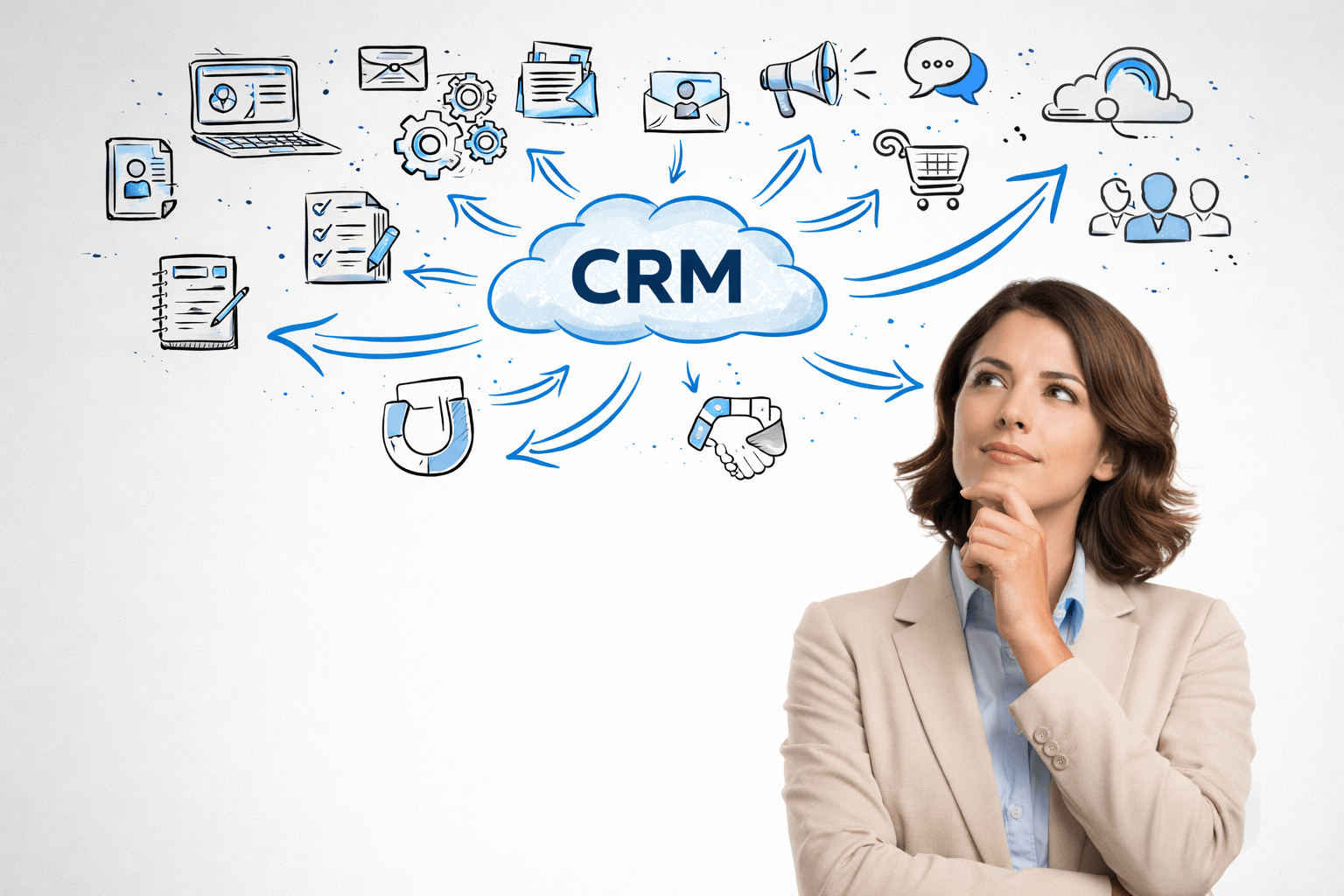
The CRM option is not as simple as it seems.
Most businesses start looking for a solution when there is already a problem. Sales do not have a clear picture, opportunities are not properly tracked, information is scattered, and each person works in his or her own way.
That's where the search begins. Which CRM should I choose?
Usually, the answer they find is comparisons. Lists with features, demos, prices, technical details. In practice, however, this does not solve the problem.
Because it's not a question of which CRM is “better”. It is which CRM fits the way the business works — or should work —.
If there is no clear picture of how sales work, no choice will be really right. The tool will simply be adapted to an already problematic situation.
That'swhy many CRM implementations fail. Not because the tool is not good, but because there is no structure behind it.
Before you get to the choice, you need to answer more substantive questions.
How are opportunities recorded today? Are there clear selling stages or does each case work differently? Is there a common picture for the whole team or is the information fragmentary? Is there a way to measure performance or do you rely on experience?
If these are not clear, then the problem is not the CRM option.
Is the organization of the commercial operation.
This is where the logic of choice changes. You are not looking for “a good CRM”. You are looking for a tool that will support a properly structured process.
A CRM that fits the business is one that can support its flow, not confuse it more. To give insight, not just data. To be used in practice, not to be left inactive.
If you want to see how this logic is shaped in practice, you can see an integrated approach in the CRM for Sales.
When the choice is made with this in mind, then the CRM ceases to be “another tool” and becomes part of the operation of the business. Sales are structured, information is coherent and management has a real picture.
Of course, CRM does not work alone.
To have value, it must fit into a broader context. Link to the overall organization of the business through ERP for Business and by exploiting the data through Business Intelligence.
Only then do you get a complete picture — from the first contact to the final result.
So if you're wondering which CRM to choose, the answer isn't in a list of features.
It's about how you want your business to work.
And if that's not clear yet, that's where you need to start.
You can see how this approach is applied in practice to CRM for Sales.
