
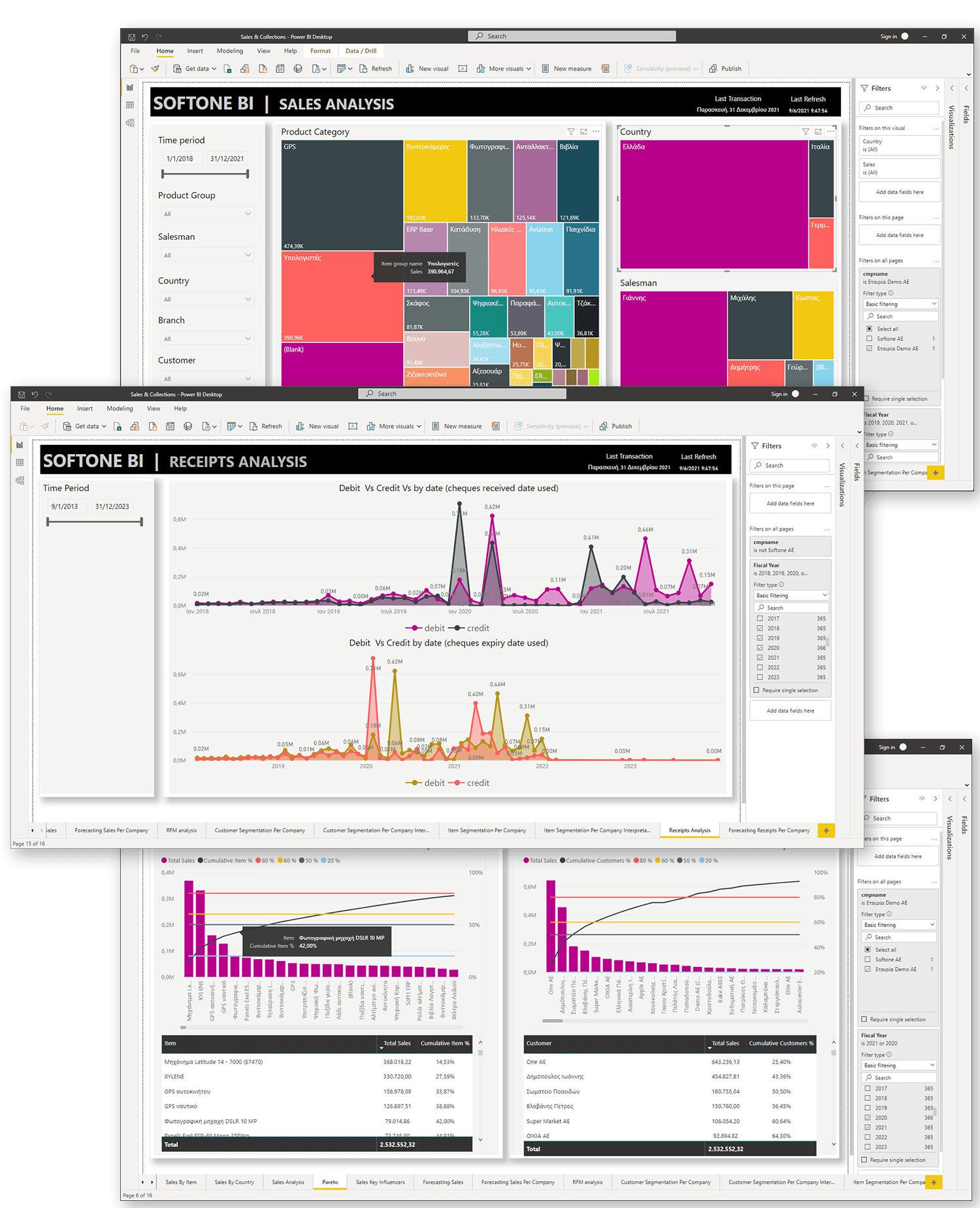
Business Intelligence is not something “new”.
It's something you're already doing.
Just not right.
Most businesses have data.
Sales, customers, stocks, finances.
In practice, however, these data are not used.
They stay scattered.
And ultimately, they don't lead to decisions.
The most common mistake is that Business Intelligence is treated as reporting.
Like dashboards.
Like graphs.
But in reality, it's much bigger.
Business Intelligence (BI) is how a business collects, analyzes, and leverages data to make better decisions.
It's not just about "seeing numbers."
It's about understanding what they mean.
That is the main difference.
Data alone is of no value.
They have value when they become insight.
When they show what works, what doesn't and what needs to be changed.
Most importantly, BI changes the way the business operates.
You don't rely on instinct.
You don't rely on experience.
You rely on the data.
Without Business Intelligence, decisions are assessments.
With Business Intelligence, they are documented.
And that makes a huge difference.
Because it allows you to see trends, identify problems and react faster.
In practice, the BI collects data from all parts of the business.
Sales, marketing, finance, operation.
It unifies them.
He analyzes them.
And it presents them in a way that you can understand and use.
A well-structured Business Intelligence & Reporting gives the business a clear picture.
Not just what has happened.
But also of what is happening now.
And what comes next.
But Business Intelligence doesn't work alone.
It needs a proper foundation.
It needs correct data.
And these come through a ERP for Business, which gathers all the information and integrates it into a total Business Organization.
At the same time, BI is critical for decision making.
Because it is directly linked to the logic of Data & Decisions.
You don't just see what's going on.
You understand why it happens.
And what you have to do.
When all this is working properly, the business changes level.
It does not work reactively.
It works strategically.
It can identify opportunities, reduce costs and improve its operation.
So if you're wondering what Business Intelligence is, the answer isn't “a tool.”
It's the way to stop guessing.
And start making the right decision.
