
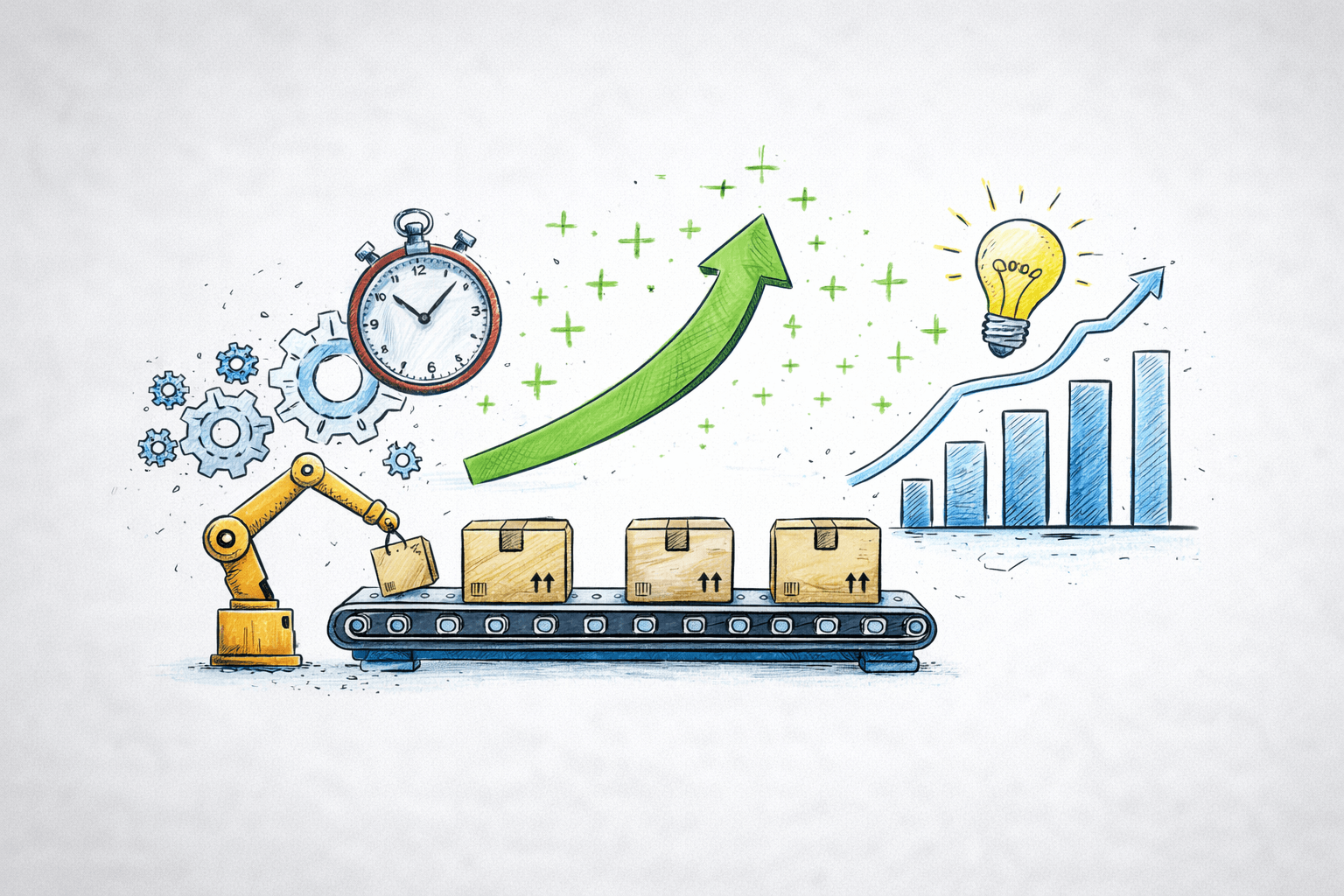
Production delays do not appear suddenly.
They are being built.
In most businesses, production “runs”. There is a schedule, there are commands, there is activity.
And despitethis, delays are constantly occurring.
It's not that there's no work.
The point is that there is no control over the flow.
In practice, delays are not due to a big problem.
They are due to small inconsistencies that accumulate.
Poor allocation of resources; lack of synchronization between stages. Delayed raw materials. Incorrect scheduling. Machines that "wait".
And the most crucial:
No timely insight into where the problem is occurring.
In each process, delays are directly linked to a lack of organization, resources, and proper coordination — not a single event .
In practice, the problem is not that there is a delay.
It is that it is not detected when it starts.
By the time you figure it out, it's already too late.
That'swhy the solution is not to put more pressure on production.
Is to improve the flow and visibility.
To be able to see where the process "sticks". Where bottleneck is created; which stage delays the rest.
If this is not clear, then the production is reactive.
And not controlled.
To reduce delays, something very specific is needed:
Continuous picture of production at each stage.
If you want to see how this logic is organized in practice, you can see the structure in the Flow & Transaction Management, where each process is connected and acquires continuity.
When this image exists, the problems are seen early.
And there you can intervene.
Before a delay is created.
At the same time, a large part of delays comes from incorrect scheduling. From shots that do not correspond to the actual production capacity.
To solve this, you need to connect the planning with the real business data.
In this logic, the overall picture comes through the ERP for Business, so that planning, production and available resources work together.
And because delays are not always obvious with simple monitoring, analysis is also needed.
Being able to see patterns. Identify repeated bottlenecks. Understand where time is wasted.
There comes the connection of utilization through Business Intelligence & Reporting, so that information can be turned into action.
In more complex environments, where handling and production are directly linked, the proper organization of the warehouse plays a key role. In this logic, you can see how the process is supported through the Warehouse Management, so as to reduce delays that begin even before the production enters.
So if you want to reduce production delays, the point is not to "run faster".
It's about working better.
Have a picture.
Identify the problem when it is created.
And intervene before it affects the whole flow.
