
ERP is not a "fad".
It's not something that all businesses need.
But for some, it is necessary.
Most businesses think of ERP with the wrong criteria.
“Are we old enough?”
But in practice, size is not the issue.
It's the complexity.
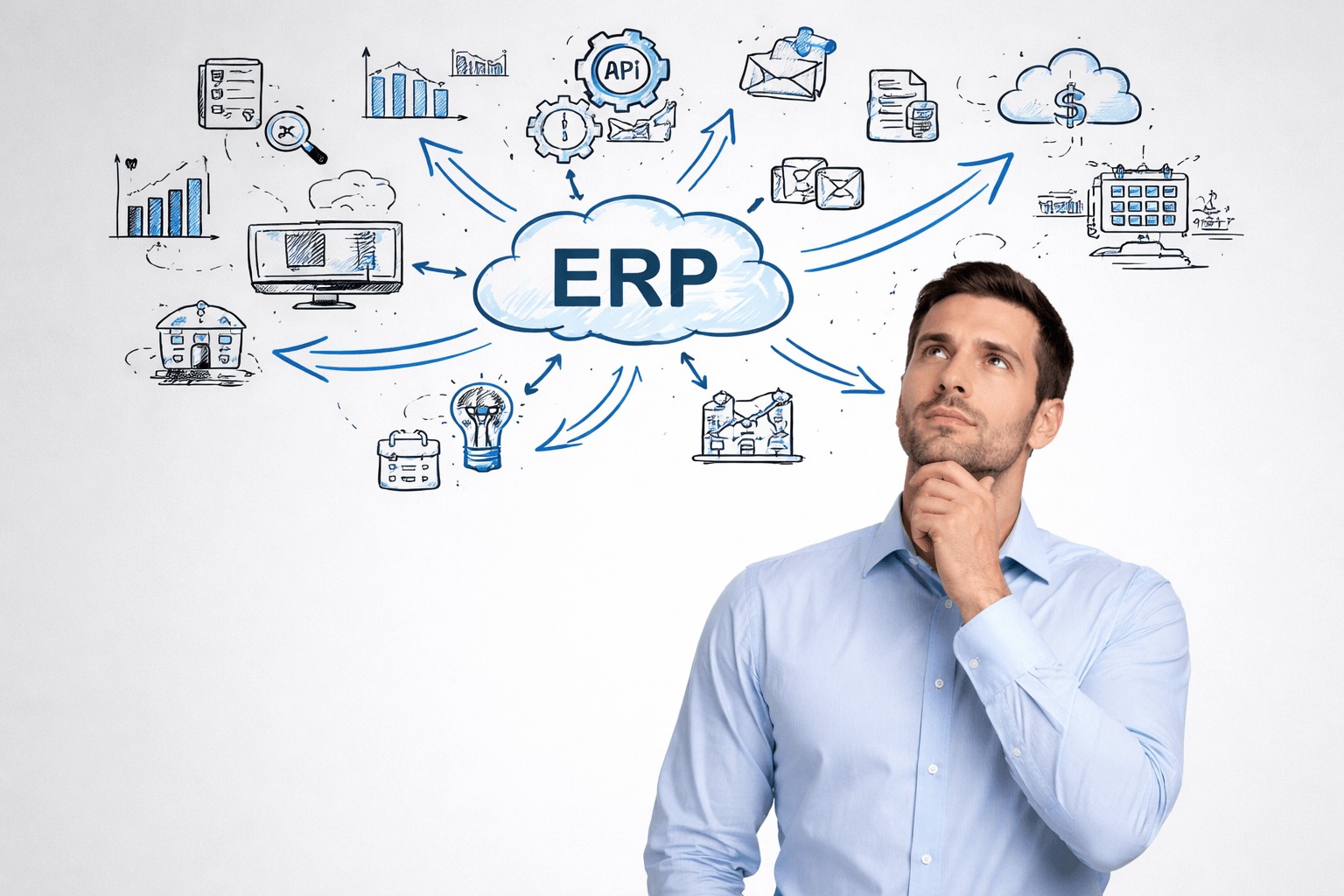
An ERP is a system that unifies all key business functions — sales, warehouse, finance, production — in a single environment
And this is of value only when there is a need for control.
ERP is suitable for companies that have started to "lose the image".
When information is scattered.
When the data doesn't match.
When each department works differently.
In these cases, ERP becomes essential to unify data and processes
Right after that, it suits businesses that are growing.
When orders increase.
When the team grows.
When management gets harder.
Developing without a system creates more problems than it solves
An ERP is also critical for businesses with multiple functions.
Production.
Warehouse.
Sales.
Distribution.
The more moving, the greater the need for coordination.
That's why ERP is used in almost all industries — from industry to commerce and services
And perhaps most importantly:
ERP suits businesses that want control.
Not just recording.
If you want to understand if you need ERP, look at the signs:
Time is wasted on manual processes
There are different numbers in each section
The information is not available when needed
Growth creates problems instead of opportunities
If these things happen, then the question is not whether you need ERP.
It's when.
At this point, a properly structured ERP for Business acts as a base.
Gathers the information.
Connects functions.
And it gives a single picture through an overall Business Organization.
At the same time, ERP does not work alone.
It is connected to the overall Management of Flows & Transactions.
And it organizes how information moves within the business.
And here is the main thing:
ERP is not for "putting in a system".
It's about changing the way you work.
When this is done right, the business is level-shifting.
It doesn't work piecemeal.
It works as a unit.
It is not based on estimates.
It is based on data.
This is where the data gets real value.
Through proper utilization Data & Decisions and tools Business Intelligence & Reporting, you can make better decisions.
So if you're wondering if ERP is right for your business, the answer is not "you're old enough".
It's a simpler question:
Are you in control?
If not, then ERP is not an option.
It's the next step.
