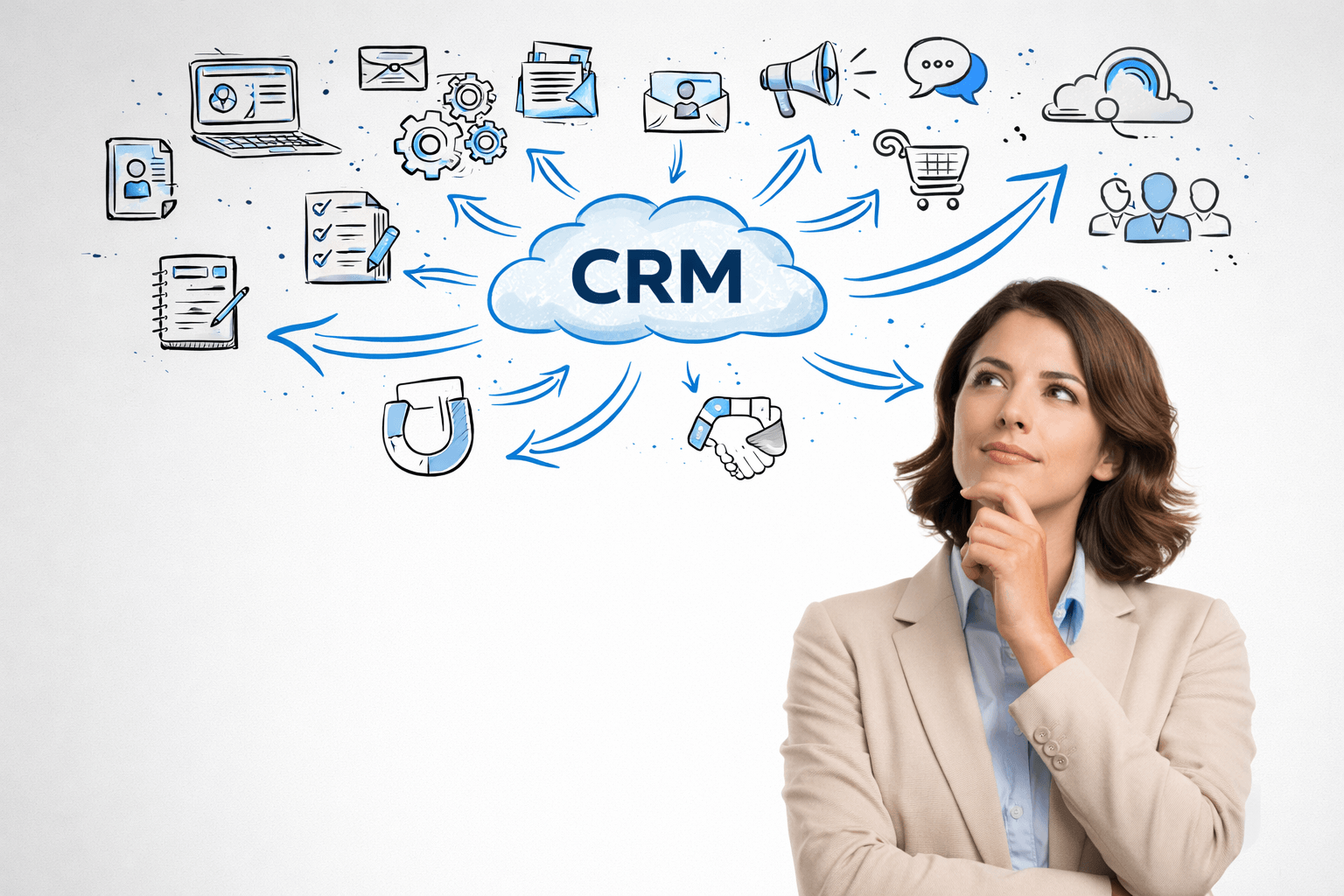
The CRM option is not a technical decision.
It is a functional decision.
And if it's a mistake, the cost isn't just economic.
It's also functional.
Most businesses start backwards.
They see tools.
Compare features.
They ask “what is the best CRM”.
In practice, however, there is no "better CRM".
There is the right CRM for your operation.
The most important step is before you see any system.
Understand why you need it.
What do you want to solve?
Where you have a problem.
Without it, any choice will be wrong.
Businesses must first set goals and needs before evaluating CRM solutions.
The most common mistake is that CRM is treated as a “sales tool”.
Actually, it's something much bigger.
It's the way you organize the relationship with the customer.
From the first lead to the sale and after that.
Next comes the issue of complexity.
Many CRMs offer dozens of possibilities.
But if you don't need them, they'll just create chaos.
The right CRM should be simple, usable and meet your real needs.
Another crucial point is integration.
CRM cannot work alone.
It must be connected to the other systems.
ERP, email, marketing.
Otherwise, it creates isolated data and loses its value.
And the most important?
CRM is not a project.
It's a way of working.
If you want to choose the right CRM, the approach needs to change.
You don't start with "which one to take".
You start with "how I want to work".
President. - Commissioner, do you wish to speak again'?
How your sales work
How Opportunities are Recorded
What are the stages
What progress means
At this point, a well-structured CRM for Sales acts as a foundation.
It does not impose a procedure.
Supports the one you set.
If you want to see how this fits in overall, you can see the approach in the Business Organization.
At the same time, the CRM must be connected to the rest of the function.
Extra points for orders
Invoicing
inventories
This is achieved through a ERP for Business and a total Flow & Transaction Management.
And here's the main thing:
The CRM should not be a “database”.
It must be a work tool.
If it is not used daily, it has no value.
When chosen correctly, it changes the way the business works.
The information is gathered.
The group aligns.
And sales get structure.
At this point, the data gets real value.
Through proper utilization Data & Decisions and tools Business Intelligence & Reporting, you can see what works and what doesn't.
And constantly improve the process.
So if you want to choose a CRM, the point is not to find the "best" one.
It's finding the right one for you.
Because there it is decided whether it will be used.
Or if there will just be one more system left.
